Prussian blue analogues
Prussian blue analogues (PBAs) are networks consisting of metal ions and cyanide linkers, originally famous for their strong blue colour. Depending on the charges and stoichiometry, PBAs range from dense redox-active systems to microporous structures with affinity for small molecules. They are now actively researched for their versatile properties spanning catalysis to ion transport. Although the average structure is relatively simple, PBAs are very playful materials that often come up with new ways of being complicated. As a result, there is still a lot to learn about their fundamental behaviour and crystallography. We have studied these materials under various conditions, to e.g. further understand how the propensity for phase transitions and flexibility depends on the stoichiometry.
Barocalorics
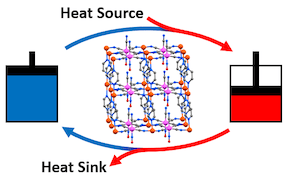
Refrigeration, as in refrigerators and air condition units, come with a high carbon footprint, on account of the energy required and the global warming potential of the gases used in the cooling process. Replacing these gaseous components by solid refrigerants would be a good way to decrease the environmental concerns. We work on so-called barocaloric materials, where a cooling effect can arise from a pressure-driven transition between two solid phases. Future use of such solid refrigerants would remove the risk of accidental greenhouse gas release from refrigeration. So far, we are exploring a range of possible barocaloric materials, including spin-crossover-active frameworks and plastic crystals.
High-pressure crystallography
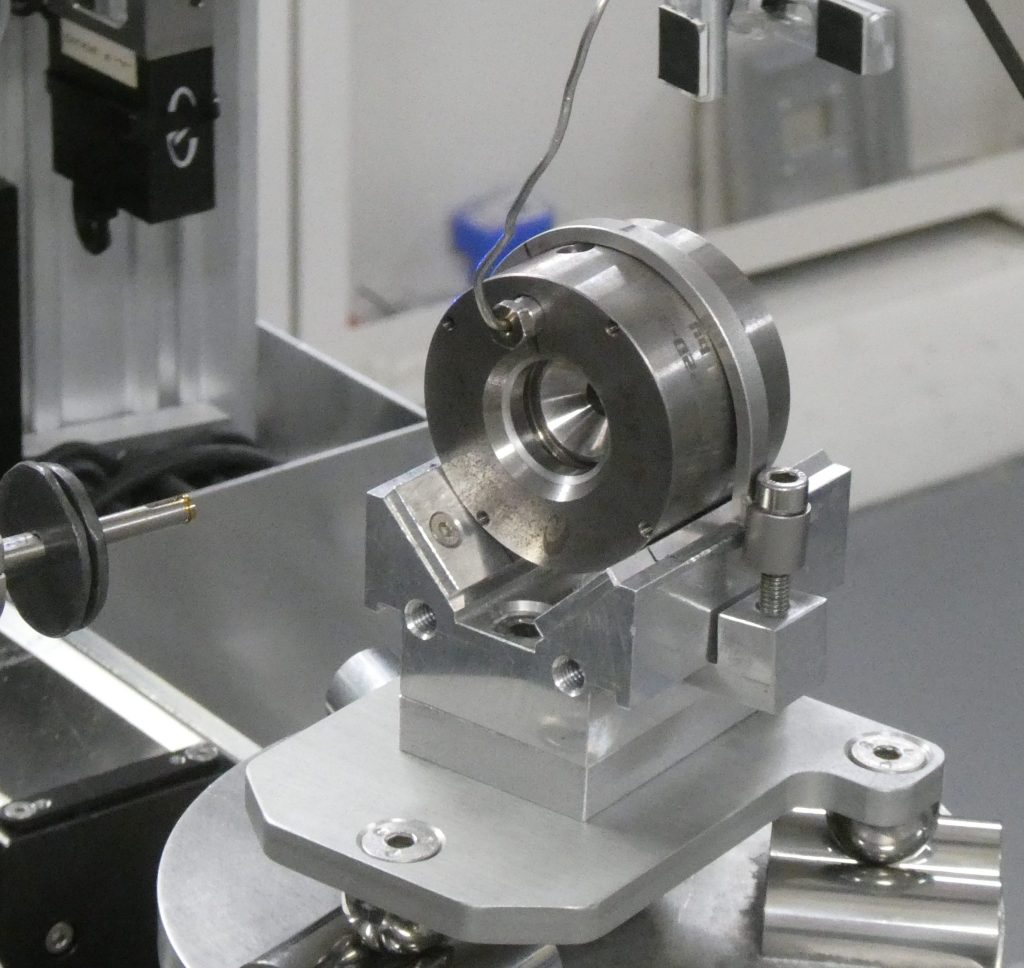
Studying materials under non-ambient conditions helps us to understand materials, for example by discovering low-energy structural distortions or investigate their tolerance to extreme conditions. High-pressure crystallography explores the structural response during compression to pressures on the order of several GPa and can often give rise to new phases that are difficult to achieve by other means. In collaboration with Andrew Cairns, we have been investigating a range of Prussian blue analogues under pressure and (amongst other fun things) discovered the first polar phase of a PBA.

